
Most people assume that persistent joint pain means surgery or a lifetime of anti-inflammatories. Physical therapy tells a different story. Through joint mobilization and manipulation, licensed therapists restore movement, reduce pain, and address the underlying mechanics that medications simply mask.
Whether you’re dealing with a stiff neck after a car accident, a shoulder that hasn’t fully recovered from surgery, or knee pain that’s crept in over years, these hands-on techniques can make a measurable difference — often without a single pill or procedure.
This guide explains what joint mobilization and manipulation actually involve, how each technique works, who benefits most, and what to expect at The Summit PT.
What Joint Mobilization and Manipulation Actually Mean
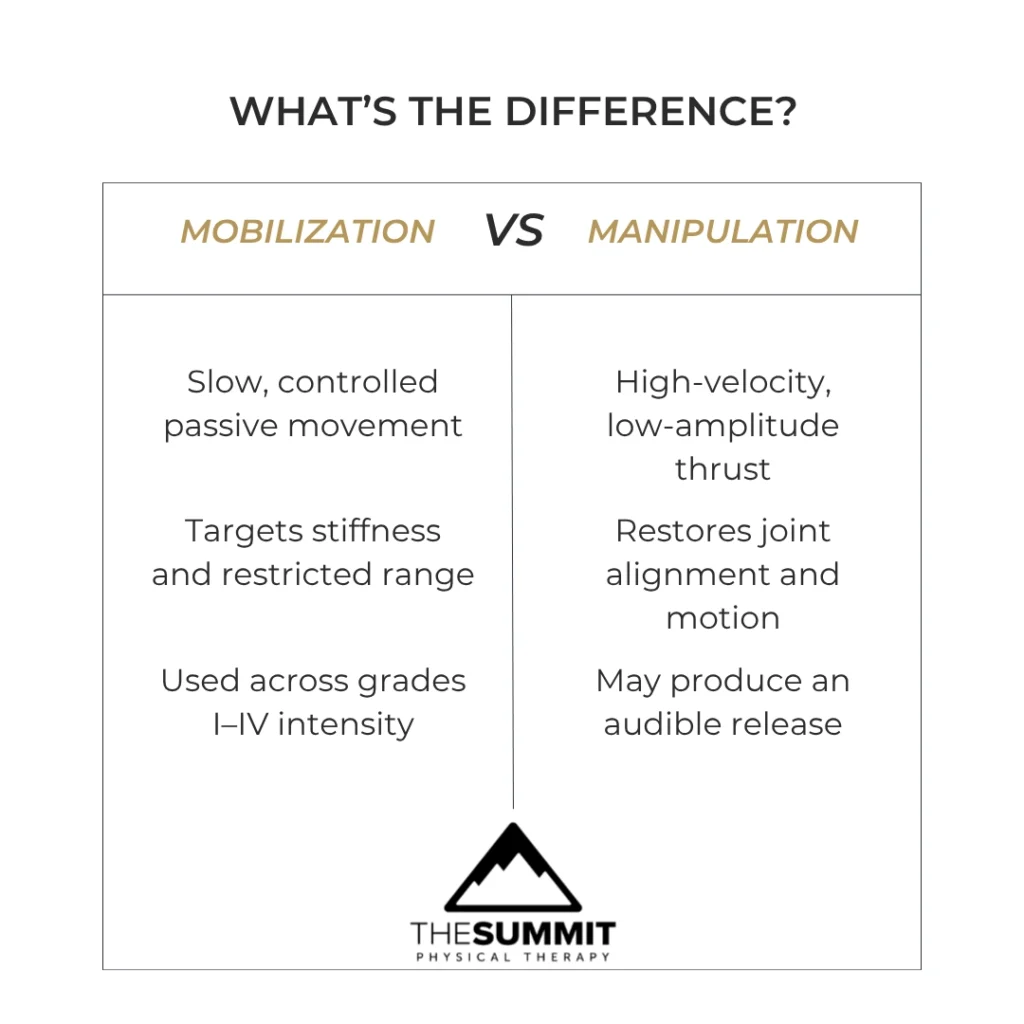
The two terms are related but not interchangeable, and knowing the difference helps you understand your treatment plan.
Joint mobilization uses slow, controlled, passive movements applied to a joint by the therapist. The goal is to improve range of motion, reduce stiffness, and restore the natural gliding mechanics inside the joint. According to research published in the Journal of Orthopaedic & Sports Physical Therapy, joint mobilization is particularly effective at reducing pain and improving function in patients with musculoskeletal conditions when applied systematically.
Joint manipulation — often called a high-velocity, low-amplitude (HVLA) thrust — delivers a precise, quick force to a specific joint segment. It is the technique responsible for the audible pop many patients experience during spinal treatment. The sound is caused by a rapid drop in pressure within the joint, releasing dissolved gases from the synovial fluid. The American Physical Therapy Association (APTA) endorses manipulation as an evidence-based manual therapy intervention for appropriate clinical presentations.
Both approaches fall under the broader category of manual therapy — treatment delivered through the hands of a trained clinician rather than a machine or medication.
The Four Main Techniques Used at The Summit PT
Physical therapists don’t use one-size-fits-all methods. The right technique depends on what the joint needs, your pain level, and how your body is currently moving.
Graded Oscillations (Maitland Grades I–IV)
The Maitland grading system classifies joint mobilization into four levels, each calibrated to where the joint sits in its range of motion and how much resistance is present.
- Grade I – Small oscillations at the very beginning of available range; primarily used for pain relief
- Grade II – Larger oscillations through mid-range; still focused on pain but beginning to address mobility
- Grade III – Large oscillations that move into resistance; targets stiffness and restricted range
- Grade IV – Small oscillations at end-range, directly into resistance; used for chronic stiffness and capsular restrictions
The therapist moves between grades based on how the joint responds, making real-time adjustments throughout a session.
High-Velocity Low-Amplitude (HVLA) Manipulation
HVLA manipulation delivers a controlled thrust beyond the joint’s passive range but within its anatomical limits. A 2021 systematic review in Spine Journal found spinal manipulation produces short-term improvements in pain and function for patients with acute and chronic low back pain comparable to other first-line treatments.
At The Summit PT, HVLA is applied selectively — only after a thorough movement assessment confirms the technique is appropriate for the presenting condition and the patient’s health history.
Mulligan Mobilization with Movement (MWM)
Developed by New Zealand physiotherapist Brian Mulligan, this technique applies a sustained accessory glide to a joint while the patient actively moves through a previously painful range. The Mulligan Concept Teacher’s Association documents consistent findings of immediate pain reduction and improved range of motion after a single session, particularly for shoulder, knee, and ankle conditions.
Unlike purely passive mobilization, MWM requires the patient’s active participation, which makes it useful for retraining movement patterns alongside improving joint mechanics.
Instrument-Assisted Soft Tissue Mobilization (IASTM)
IASTM uses stainless steel instruments to apply targeted pressure to myofascial tissue — muscles, tendons, fascia, and ligaments. The tools allow the therapist to detect and address scar tissue, adhesions, and restrictions that are difficult to locate manually. According to research published in the Journal of Exercise Rehabilitation, IASTM improves local blood flow, stimulates connective tissue remodeling, and reduces pain compared to control conditions.
At The Summit PT, IASTM therapy is commonly combined with therapeutic exercise to build functional strength into the tissue once restrictions are cleared.
What Conditions Respond Best to These Techniques
Joint mobilization and manipulation are not appropriate for every patient or every diagnosis. Therapists at The Summit PT assess each case individually to determine if manual therapy is indicated and which technique best matches the clinical picture.
Conditions that commonly respond well include:
- Neck and low back pain — particularly mechanical pain without neurological symptoms
- Post-surgical stiffness — shoulder, knee, and hip replacements often involve restricted capsular mobility that responds to graded oscillation
- Osteoarthritis — mobilization maintains joint lubrication and slows the progression of motion loss
- Adhesive capsulitis (frozen shoulder) — sustained end-range techniques help restore shoulder rotation progressively
- Sports and overuse injuries — ankle sprains, tennis elbow, and IT band syndrome often involve joint restrictions that prevent full recovery
- Car accident injuries — whiplash and cervical joint restrictions frequently require both mobilization and soft tissue work
Patients with active fractures, severe osteoporosis, certain vascular conditions, or joint instability may not be candidates for manipulation. A complete intake evaluation at The Summit PT determines whether manual therapy is safe and appropriate before any hands-on treatment begins.
The Role of Spinal Manipulation in Back and Neck Pain
Spinal manipulation is one of the most studied manual therapy interventions in physical medicine. The Clinical Practice Guidelines from the APTA include manipulation as a Grade A recommendation for patients with acute low back pain — the highest level of evidence-based endorsement available.
The mechanism is multilayered. Manipulation creates a rapid pressure change in the joint that may temporarily reduce pain-sensitizing chemicals, inhibit local muscle guarding, and restore segmental mobility that postural habits and injury have restricted over time. For many patients with neck pain or headaches of cervicogenic origin, targeted cervical manipulation significantly reduces symptom frequency.
Physical therapists trained in spinal manipulation complete additional post-graduate coursework and use differential diagnosis to rule out red flags before applying the technique. The level of training and clinical reasoning involved is substantially different from a generic adjustment at a non-clinical setting.
What to Expect During a Joint Mobilization or Manipulation Session
Your first session begins with an evaluation, not treatment. Your therapist will assess posture, active range of motion, joint end-feel, and pain behavior to map out which structures are contributing to your symptoms.
During manual therapy, you’ll typically lie or sit on a treatment table while the therapist positions the target joint. You may feel mild pressure, gentle oscillating movement, or — with manipulation — a quick thrust that produces an audible release. Most patients describe manipulation as startling but not painful; some report immediate relief of the tightness they came in with.
Sessions are typically 45–60 minutes and may involve manual work, followed by therapeutic exercise to reinforce the mechanical changes made during mobilization. Lasting improvement requires both.
Post-treatment soreness, similar to the feeling after a good workout, can occur for 24–48 hours. This is a normal response as tissues adapt. Persistent or worsening pain after a session is worth reporting to your therapist — it’s uncommon but guides adjustment of the treatment approach.
Frequently Asked Questions
Is joint manipulation safe?
Yes, when performed by a licensed physical therapist who has screened for contraindications. Serious adverse events from cervical or lumbar manipulation are rare. Your therapist completes a full intake evaluation before applying any high-velocity technique to confirm it’s appropriate for your specific condition.
Does joint mobilization hurt?
Most patients describe mobilization as mild pressure or gentle movement — not pain. Grade I and II techniques are specifically designed to reduce pain rather than provoke it. Higher-grade techniques can produce some discomfort as they address stiffness at end-range, but this should be tolerable and subside quickly after treatment.
How many sessions will I need?
This depends on your diagnosis, how long the problem has been present, and your response to treatment. Acute conditions often improve within 4–6 sessions. Chronic or post-surgical conditions may require 8–12 or more. Your therapist will reassess your progress regularly and adjust the plan accordingly.
Can I get joint mobilization after surgery?
In many cases, yes — and it’s often an important part of post-op recovery. Capsular restrictions and scar tissue commonly develop after shoulder, knee, and hip procedures. The timing and intensity of manual therapy after surgery depends on surgical protocol and healing stage. Your therapist will coordinate with your surgeon as needed.
What’s the difference between physical therapy manipulation and a chiropractic adjustment?
Both use manual techniques to address joint dysfunction, but the context differs. Physical therapists integrate manipulation within a broader rehabilitation program that includes exercise, strength training, and movement retraining. Chiropractors may use manipulation as the primary or sole treatment. Neither approach is universally superior — the best fit depends on your diagnosis and treatment goals.
Movement Is Recoverable But It Requires the Right Approach
Joint pain rarely resolves on its own when the underlying mechanics remain compromised. Mobilization and manipulation work because they address the joint directly — restoring the glide, reducing the guarding, and giving the surrounding muscles a chance to function the way they were designed to.
The Summit PT therapists bring these techniques to every appropriate case, calibrating each intervention to what the joint and patient actually need — not a protocol. If persistent stiffness, pain after injury, or post-surgical motion loss has been limiting your daily life, schedule a visit to find out whether joint mobilization or manipulation belongs in your recovery plan.