
Most people assume that if something goes wrong with how they walk, time alone will fix it. It won’t. Altered gait — whether from a stroke, a joint replacement, a spinal injury, or even a prolonged period of inactivity — becomes self-reinforcing. The longer the body compensates with faulty movement patterns, the harder those patterns are to unlearn. Gait training in physical therapy exists precisely to interrupt that cycle before it becomes permanent.
At The Summit PT, gait training is one of the most clinically intensive services we provide. It is not walking on a treadmill and being told to try harder. It is a structured, evidence-based process of identifying what has gone wrong in your movement chain and systematically correcting it — stride by stride.
This guide covers what gait training is, who needs it, what treatment looks like, and why starting sooner rather than later produces significantly better outcomes.
What Gait Training Actually Involves
Gait training is a specialized rehabilitation approach that targets the mechanics of walking — the sequence of muscle activations, weight shifts, joint positions, and neuromuscular signals that must coordinate correctly for safe, efficient movement. When any part of that chain breaks down, the entire system compensates, often creating secondary problems in the hips, knees, or lower back.
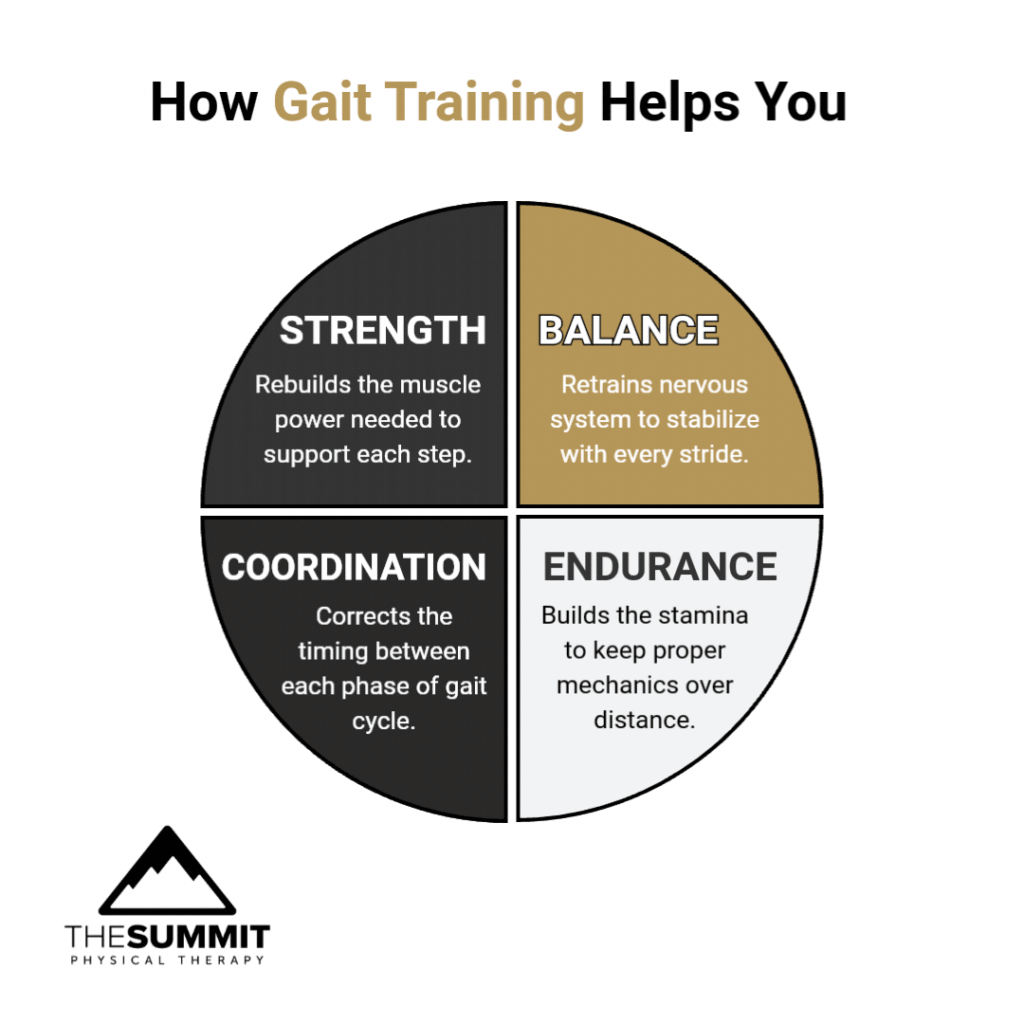
A gait training program in physical therapy addresses four primary components:
Strength.
Weakness in the glutes, hip flexors, quadriceps, or ankle dorsiflexors is one of the most common drivers of abnormal gait. Targeted strengthening exercises rebuild the muscle capacity needed to support normal walking mechanics.
Balance and proprioception.
Your body’s ability to sense where it is in space is often disrupted after neurological events or joint surgery. Proprioceptive training — practiced on varied surfaces, with eyes open and closed — retrains the nervous system to stabilize the body during each phase of the gait cycle.
Coordination and timing.
The stance phase and swing phase of walking must occur in precise sequence. Gait retraining exercises isolate each phase to correct the timing of weight transfer, foot clearance, and push-off.
Endurance.
Walking requires sustained output, not just a few correct steps. Gait training progressively builds the cardiovascular and muscular endurance necessary to maintain proper mechanics across real-world distances and surfaces.
How a Physical Therapist Evaluates Your Gait
Effective gait training begins with a thorough movement evaluation — not a general fitness assessment, but a clinical examination focused specifically on walking mechanics.
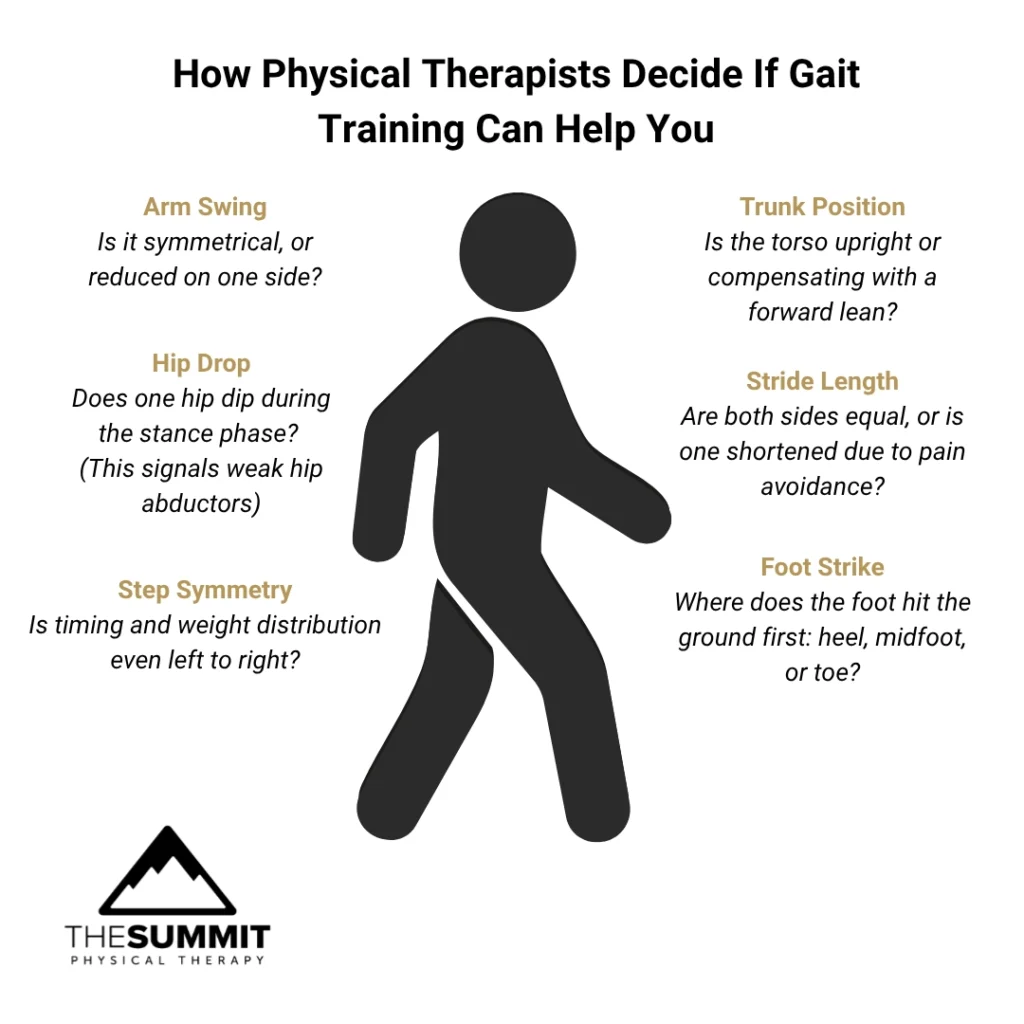
Your Summit PT therapist will observe your stride length, step width, foot strike pattern, trunk position, arm swing, and the symmetry between your right and left sides. These observations reveal compensations that you likely are not aware of: the slight hip drop that signals weak hip abductors, the shortened stride on one side that indicates pain avoidance, the forward trunk lean that suggests poor ankle mobility.
In addition to visual assessment, your therapist will evaluate range of motion, muscle strength, sensation, and balance in the lower extremities. This combination of functional observation and clinical testing produces a complete picture of where your gait is breaking down and why — which makes the treatment that follows far more targeted than a generic exercise program.
Gait Training Techniques Used at The Summit PT
Treatment is not one-size-fits-all. The specific techniques used depend on the underlying cause of your gait impairment and your recovery goals. At The Summit PT, therapists draw from a range of evidence-based interventions within our gait training treatments.
Treadmill training
Allows precise control of walking speed and incline, enabling therapists to incrementally challenge patients as they improve. Research published in Archives of Physical Medicine and Rehabilitation supports treadmill-based locomotor training as effective for improving walking function after incomplete spinal cord injury.
The Track & Harness System
A specialized track-and-harness system is available at The Summit PT that provides partial bodyweight support during walking practice. This allows patients with significant weakness or instability to practice proper gait mechanics safely, at levels of weight-bearing they could not otherwise tolerate. As strength and control improve, support is reduced progressively.
Overground walking practice
On varied surfaces — including uneven terrain, inclines, and obstacle courses — builds the proprioceptive adaptability that flat-surface treadmill work alone cannot provide. Walking on surfaces like grass or sand forces the stabilizing muscles to engage differently with each step, building the reactive stability that real-world walking demands.
Verbal and tactile cueing
During active practice gives the nervous system immediate, specific feedback about movement quality. Cues like “push off with your toes” or “keep your knee over your second toe” are more effective at changing motor patterns than exercise alone, particularly for patients with neurological conditions.
Task-specific training
Incorporates functional movements — negotiating curbs, carrying objects while walking, navigating through a doorway — to ensure that improvements in the clinic transfer to the patient’s actual daily environment.
Who Benefits from Gait Training
Gait training is not exclusively for patients with severe disabilities. It is appropriate for any situation in which walking mechanics have been disrupted or where they could be improved.
Post-surgical patients
Particularly those recovering from hip or knee replacements, spinal surgery, or fracture repair — almost always develop compensatory movement patterns during the period when they are protecting a healing structure. Gait training after surgery systematically dismantles those compensations and restores normal mechanics before they become habitual.
Stroke survivors
Face one of the most complex gait rehabilitation challenges. Hemiplegia or hemiparesis — weakness or paralysis on one side of the body — creates an asymmetrical gait pattern that, left unaddressed, increases fall risk and limits independence. A 2013 systematic review in Archives of Physical Medicine and Rehabilitation found that locomotor training improved walking speed and function in patients with incomplete spinal cord injury, and similar principles apply to post-stroke rehabilitation.
Patients with Parkinson’s disease
Experience gait disruption from the disease’s effect on the basal ganglia, leading to a characteristic shuffling pattern, reduced arm swing, and festination. Gait training — particularly rhythmic auditory stimulation and cueing strategies — has demonstrated measurable improvements in stride length and cadence in this population.
Older adults
Experiencing balance problems, fear of falling, or general deconditioning benefit from gait training as both a rehabilitation and preventive intervention. Falls are the leading cause of injury-related death among adults 65 and older according to the CDC, and structured gait and balance training is among the most evidence-supported interventions for fall prevention.
Athletes and active individuals
Returning from lower extremity injuries — ACL reconstruction, Achilles tendon repair, stress fractures — use gait training to ensure that they return to sport with biomechanics that protect the repaired structure and don’t create secondary injury risk elsewhere.
When to Start Gait Training
The answer, in nearly every case, is sooner than most patients think.
Early mobilization — initiating walking practice within the appropriate post-surgical or post-event window — produces better outcomes than waiting until pain or weakness has fully resolved. Prolonged rest allows compensatory patterns to consolidate and leads to muscle atrophy that then requires additional time to reverse.
Your surgeon or physician will define the appropriate timeline for weight-bearing after a procedure. Within that timeline, a Summit PT therapist will design a gait training progression that is safe, structured, and calibrated to where you are right now — not where you hope to be in six weeks.
Frequently Asked Questions About Gait Training
How long does gait training take?
Duration depends entirely on the underlying cause and your starting point. A patient recovering from a straightforward knee replacement may see meaningful improvements in four to eight weeks. A stroke survivor with significant hemiparesis may work on gait training for several months. Your therapist will set measurable benchmarks so you can track progress throughout.
Is gait training painful?
Gait training should not cause pain. Some muscle soreness following sessions that include strengthening work is normal, but if you experience sharp or increasing pain during gait exercises, that is information your therapist needs. The program will be adjusted accordingly.
Can I do gait training exercises at home?
Yes, and home exercise is typically a component of a well-structured program. Your therapist will provide a home program that complements in-clinic sessions. However, the cueing, surface variation, and real-time correction that happen in clinic are difficult to replicate independently, which is why in-person sessions remain central to meaningful progress.
Does insurance cover gait training?
Gait training performed as part of a physical therapy plan of care is generally covered by most insurance plans when there is a documented medical need. The Summit PT team can help verify your benefits before your first session.
What’s the difference between gait training and just practicing walking?
Unguided walking practice reinforces whatever pattern you currently have — including compensations. Gait training, by contrast, uses structured assessment, targeted exercises, and real-time cueing to identify and correct the specific mechanics that are failing. The difference is the difference between practicing a bad habit and replacing it with a better one.
Start Gait Training at The Summit PT
If your walking has changed — after surgery, a fall, a neurological event, or gradual decline — gait training can help restore what you have lost. The Summit PT has multiple locations across the Fresno area, including Buchanan, Clovis, Fig Garden, Reedley, and Selma, with therapists who specialize in movement rehabilitation. Call us at 844-969-4122 or schedule a visit online to begin your evaluation.